
WHY READ END TIMES NOW
By Laura Sager
The news cycle is a swirl of existential threats and climate-and war/genocide-driven human devastation caused by leaders who have openly discarded any respect for human life. The converging crises: climate acceleration, rapid AI deployment (that major developers openly admit could end humanity), ongoing wars/genocide that are increasing threats of nuclear weapon use, widening social and economic inequality, and an international sadistic war on migrant families, are all being celebrated by a bewildering array of voices demanding that we hate our neighbors, digitize our lives and selves, ignore the future (don’t look up), and burn, baby, burn.
All these crises are indeed creating a new and ever-more dangerous world. But if we simply freeze, turn away, panic, or retreat into nostalgia for the past, we join a progression of mourners rather than the fighters we were meant to be. But to fight to win means you must carefully identify the forces at play to recognize the path forward, educate the majority being herded toward extinction, and organize for nothing less than the continuation of life on our precious planet.
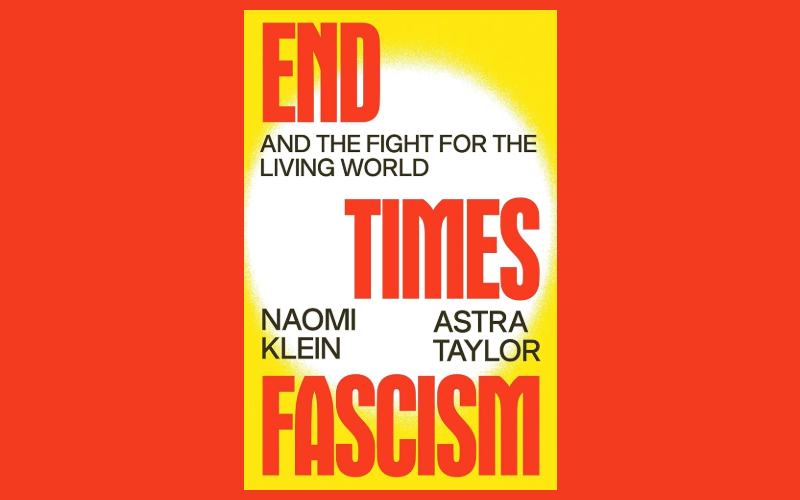
Thankfully, on September 15, Naomi Klein and Astra Taylor released End Times Fascism: And the Fight for the Living World. They have written an essential and accessible guide to the forces leading the apocalyptic thinking and supremacist ideas now part of mainstream elite discourse.
End Times Fascism is an investigation into who is actively making the world unlivable while preparing their own private escape routes, and how ordinary people like you and I can resist.
What Klein and Taylor call “end times fascism” describes a phenomenon that wasn’t visible even five years ago. As Klein notes in her New York Times Magazine interview, tech elites who were “launching an Earth Prize” and promising to save the planet have shifted toward narratives that justify selective survival — “whose lives count and whose lives can be discarded.” Understanding this pivot requires seeing it as structural, not merely psychological. Money itself is selecting for the ideology.
It’s not enough to catalog symptoms of our emergent fascism without naming the connective tissue. Klein and Taylor synthesize three seemingly unrelated factions — religious fundamentalists, Silicon Valley technologists, and ethno-nationalists — into a single analytical framework. Kirkus called this “an astute, original-minded analysis,” and reviewers across the spectrum credit the authors with giving us “a comprehensive interpretation of What It All Means, Why It’s Happening and How We Should Respond.”
A common trap in crisis literature is to document catastrophe so thoroughly that action feels impossible. End Times Fascism avoids this by introducing “hereness” — a counter-politics rooted in staying loyal to the planet and each other rather than fleeing. The authors point to organizing wins: activists in Memphis opposing data centers, anti-ICE mobilizations in Minneapolis, and Zohran Mamdani’s win in New York. These are documented cases of resistance that exploit the internal contradictions of the end times alliance. The many internal conflicts and contradictions in this doomsday coalition leave elite survivalists vulnerable to a new kind of ‘pro-life’ politics.
So many people in our Lansing area community are doing outstanding work already on a multitude of fronts – data centers, police surveillance/violence, Palestine, housing, deportations, anti-war, and electoral support for progressive candidates. It is this patient, quotidian, life-affirming, and objectively anti-fascist work that prepares communities for even greater challenges.
However, we also need a collective strategy that is informed by End Times Fascism, which identifies where the enemy is weakest: their nihilistic inability to envision shared futures, even for ostensible allies. This will help us organize around precisely that fracture line. Exposure weakens the “end times” coalition’s hold, which means the work of naming it is itself strategic, not merely intellectual.
Why do Klein and Taylor explicitly defend keeping the word “fascism” despite ongoing debates about the use of the term? Their reasoning — fascism evolves with its environment — illuminates how fascism actually has exercised control in various nations and eras. For example, the fascist governance system in the American pre-Civil War South, especially the “Black Codes,” provided a template for Hitler’s Nazi party.
So – and this is a key point – we’re not looking at a rerun of 1930s fascism, but a sequel with existential stakes no earlier fascist could imagine. And that points us to the structures being both undermined and then being rebuilt to serve the survivors of the hoped-for “culling” of millions of humans and non-human animals.
So, please read this book now because the phenomenon it names is accelerating, the vocabulary for understanding it is still crystallizing, and the window to build counter-power depends on accurate diagnosis before retreat becomes irreversible. Klein and Taylor have done the synthesis; the rest depends on those who decide what to do with it.
Want to think about this with others? I am organizing a two-session book discussion of End Times Fascism for late October. If you or your organization want to join in, just email me at lmsager@pm.org and let me know the best times and dates to participate. The book is widely available in the usual formats. If your library or library loan doesn’t have it, ask them to expedite getting it.
Democracy Now! Interview with Klein and Taylor: https://www.democracynow.org/2026/9/15/klein_taylor_end_times_fascism
https://www.commondreams.org/news/bernie-sanders-riverside-church